Showing posts with label tandc. Show all posts

Wednesday, April 7, 2010

Macarons, attempt one.

Macarons are perhaps past the peak of their popularity now, but they're still incredibly tasty. A French confection, a bit like our very own macaroons but smaller, more delicate and filled with tasty creams and coloured like flowers, macarons are starting to be found in locations outside London. Quelle horreur!

The usual suspects in London are Ladurée and Pierre Hermés in Selfridges, but I noticed Maison du Chocolat had started knocking them out in little boxes and other places - bakeries and patissieres - experimenting. They are highly flavoured, delicate, soft and crunchy at the same time, very sweet and also often bizzare. The classics are peerless; I have a particular fondness for Ladurée's caramel-filled and their coffee macaron are heaven. You can only eat a couple at a time because they are rich and sweet, but the texture and flavour explosions are sublime.

Finding them in Leeds, of course, is not likely to happen anytime soon so the only way to get them here is to make 'em. If you've ever tried making meringue before you'll know it takes more than just a smile and a quick whizz of the whisk; everything can affect how well they come out, and macarons are worse. A friend's father-in-law is a genuine, honest-to-goodness French patissier and even he steers clear of macarons because they are a faff to make. The sugar you use, the almonds, the humidity of the kitchen, and even the heat distribution of your baking sheets can make a huge difference, and if you over or under-mix by the tiniest amount the difference can be a soggy puddle or a cracked brick.

Sounds like a challenge to me.

Having read the delightful Not So Humble Pie's macaron 101 I decided that simple would be better, and I wouldn't start messing about with colours just yet. Concentrate on getting the macaron right first, get a decent filling and then start making them look pretty. This, obviously, wasn't going to happen on my first attempt. I'd picked up a copy of Hisako Ogita's I Love Macarons and decided to follow the recipe for French macarons, just because I didn't like the idea of making sugar syrup in the microwave just yet.

I'm not detailing the recipe here (not until I have a fully working example!) but basically you go through the following steps:
  • Mix ground almonds and icing sugar.
  • Whisk egg whites.
  • Add sugar to egg whites and whisk some more.
  • Add sugar/almonds to egg whites.
  • Pipe onto baking sheet...
  • bake!

See? Simple. Except it isn't; I have a fear of overwhisking egg whites, after doing it a few years ago and turning my lovely, stiff peaks back into mush (by hand, too). And there are certain rules that you have to follow to enable the results to be called "macarons". I didn't really get the results I should have, so all I can call them is "almond cookies". Very tasty almond cookies, though.

First of all; they didn't rise the way they should have. I didn't beat the egg whites enough, and they cracked, and coloured too much, so the oven was too hot (despite the oven thermometer) and I didn't leave them to dry out enough. I suspect the mix was too runny, and the foot (la pied) didn't rise anywhere near as much as it should. Indeed, on many it didn't rise at all. My baking sheet wasn't totally flat and I cooked them on parchment, so didn't lift off as easily as they should have. The edges got a little singed, and one batch accidentally caught on fire when the parchment got a bit too close to the oven flame.

But, they tasted fantastic. I made a coffee buttercream filling for half of them, and some lemon curd (well, I needed to use the yolks) for the other half. The coffee ones looked like this:
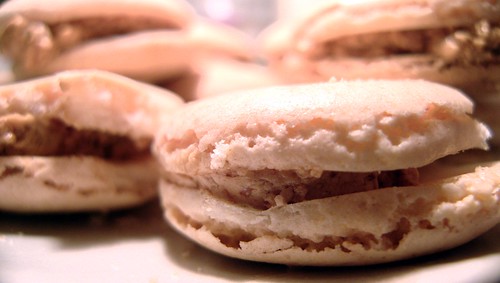
Coffee Macaron

Seriously tasty.

Hints for next time: after filling, put in the fridge in an airtight box, not on a plate. These things soak up atmospheric water like... well, like meringues. They are very hygroscopic. The filling needs to be stiffer, too. I need new baking sheets (if anybody reading wants to send me review copies of baking sheets, I'll happily give them a try!) and I should try using Teflon instead of parchment. Colouring, and flavouring the macarons themselves should be attempted. And I need to be braver when it comes to beating the egg whites.

So this was attempt number one. I'll be trying this again soon, and will let you know how I get on.

Monday, March 15, 2010

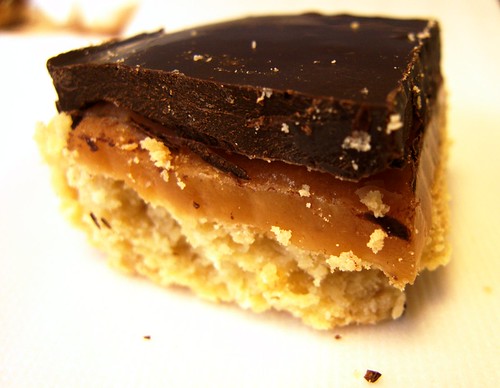
Millionaire Shortbread

Millionaire Shortbread

This weekend saw me making millionaire shortbread. Generally speaking, shortbread by itself is lovely, lovely stuff. Adding a layer of caramel to it, and then a layer of chocolate could be seen as gilding the lily slightly. But as a delivery mechanism of high-class carbs and fat there are few things finer. But - and this is a big but - it has to be home-made. Shop-bought millionaire shortbread has a too-thin layer of chocolate and caramel, and the shortbread itself is strange stuff. Come to think about it, even the chocolate and caramel is a bit peculiar, but the shortbread is often more like cheesecake base than proper, crisp, shortbread, and is far too crumbly. The chocolate layer is far too thin and to get it that thin it has to be too warm and probably contains oil and a stabliser of some description. The caramel? Invariably it's dulce de leche, or rather an industrial variant thereof. It tastes of sugar and vegetable fat, with none of the creaminess or texture a good caramel should have.

There's a rant about caramel that I've had for a while; boiling a tin of condensed milk does not make a caramel, it makes dulce de leche, a sticky, thick-ish sauce that tastes of, well, condensed milk. A good caramel is soft and slightly chewy and creamy and has a slight overtone of whatever sugar you used to make it, which is why I make caramel with a mix of sugars (recipe below). And if you're making millionaire shortbread you can't use dulce de leche, because it's too runny. I'll admit, in certain circumstances it's ok stuff (sort of, I'm not really a huge fan), but as a sauce or flavouring, not an structually integral part. Anyway, making a caramel is really very easy, which is why my rant gland starts up whenever I see a jar of dulce on the shelves (at some ridiculous price).

(Technically, a proper caramel is just boiled sugar which has undergone pyrolysis, but for the sake of this post I'm talking about dairy caramels.)

We've established that good millionaire shortbread is homemade, and one more reason is that you can change the thickness of your layers to how you like them, and adjust portion size accordingly. Also, you know what's gone into it and if you like to experiment adjusting the various ingredients to suit your own tastes is simple, and can make some quite exciting treats. Let's look at the basic recipe.

1. Shortbread. This can be as simple or complex as you like. My base recipe (8" square tin) is 150g butter, 75g caster sugar creamed together, and 175g plain flour and 25g semolina beaten into it to form a soft, quite sticky dough. Line your tin with baking parchment so that it covers the base and sides and squish the dough into it with your fingers so that it forms an even layer, then poke the base with a fork a few times and bake at 160C for 25 minutes, ish, until it is golden brown in colour. But, tweak the recipe to suit your tastes; add lemon zest, or lavender, or cardamom to the butter & sugar. Swap some of the flour for cocoa. Add toasted hazelnuts to the mix, or finely chopped stem ginger.

2. Caramel. Once the shortbread has come out of the oven, make your caramel. Don't mess about with this too much - although experiments are good - as the ratios have to be fairly close to stop it recrystallising. I like my caramel to be chewy, but not so much that it'll pull fillings; it does have to have some structural integrity as the chocolate layer needs supporting, so it'll need to hit the soft-to-firm ball stage. In a small heavy-bottomed saucepan put 225g caster sugar, 25g butter and 140ml (a small pot, IIRC) of double cream. Over a low heat, gently stirring constantly, melt everything together, then once the sugar has dissolved turn the heat up and boil until it reaches 120C. If you don't have a sugar thermometer boil for five minutes, take a teaspoon of the caramel and drop into iced water, then try to form the caramel into a ball using your fingers; if it keeps its shape when you take it out of the water it's done, otherwise put the caramel back on the heat for another two minutes (or longer, if the caramel didn't form into a ball underwater) and try again. If it's done, add a good pinch of salt and stir, then pour onto the shortbread; it should spread itself out evenly. To experiment with this layer, you could add similar flavourings to above, but I wouldn't bother. I would, however, tinker with the sugar; use 50/50 white caster and light soft brown, or dark soft brown, or even demarera. You can over or undercook the caramel to make it more or less chewy, but be careful of this. I'll do a post on caramels as sweets in a couple of weeks.

3. Chocolate. Melt some chocolate - about 100g will cover an 8" tin - with a knob of butter and pour it over the caramel. Do what you like here; add chili, more lemon zest, peppermint oil, or melt some contrasting coloured chocolate and swirl it using a cocktail stick, whatever you like. then leave to cool, and refrigerate until completely set. Then take the whole lot out of the tin on the baking parchment and chop into squares, bars, circles, whatever shapes and sizes you like depending on how much of a diabetic coma you like.

Tadah! There's a lot of words up there, but you can summarise them as "make shortbread, make caramel (don't be tempted by dulce de leche), and melt some chocolate". And the results? Oh, so worth it. And it's really difficult to make a bad millionaire shortbread.

Tuesday, February 16, 2010

Gingerbread men! Lots and lots of gingerbread men!

Concerning gingerbread people.

You know, if we were professional bakers we probably could have had this done and dusted in half the time. A third of the time. Total man hours required for myself and Sam (of Tea and Cake fame) to make 100 gingerbread people turned out to be about 14; my standard hourly rate (for callouts) is £50, which makes these some of the most expensive gingerbread men ever made. Or, would do, if we were charging for anything other than ingredients.

But, we did it, they are done and we did them. 100 gingerbread people, as a T&C enterprise for one of Sam's friends, getting married one Saturday in November and wanting wedding favours for people. You know how I say things like "try everything once, just so you know you'll never have to do it again"? Well, without a bigger oven, a higher working surface and something to pulverize crystallised ginger without gumming up I'm never making this many gingerbread men again...

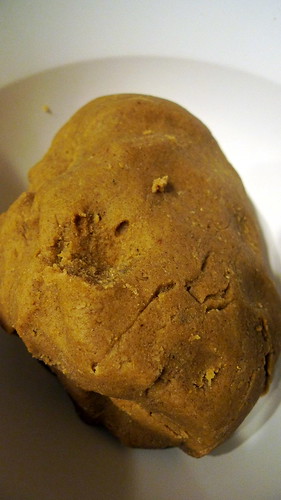
The recipe was the standard one that I swiped from my mother, and modified slightly with some different spices and some maple syrup, with the extra addition of a couple of tablespoons of blitzed crystallised ginger. It's a bit gummy, that stuff, so my hand mixer didn't really like it very much. It makes quite a difference to the mixture, though - a bit of texture and some more ginger in there, without having big lumps of mouth-searing surprise. Fifty raw gingerbread men look like this:

Dough Raw

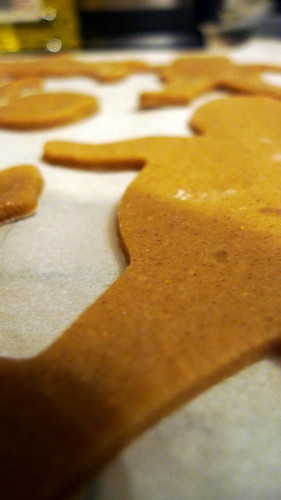
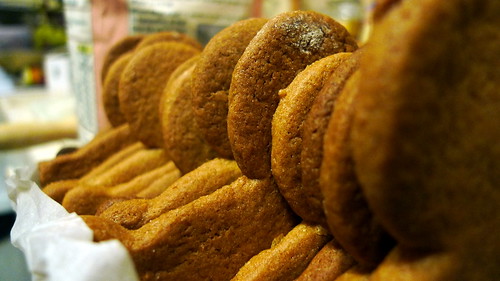
... and as they were cooling, but before I put them in airtight tins, they looked like this:

Awaiting decor

Stacks

They stayed crisp overnight (hoorah!) in the airtight tins, but I did have to make another batch before going to bed because some were a bit too singed around the edges and were more like those biscuits you get in plastic packets when you order coffee in hotels that are trying, but don't quite get coffee. Perfectly edible if you like that sort of thing, but not really suitable.

Met Sam at the station, we went home and took out the ladies that she'd done, melted some chocolate (which set really quickly, so I decided that properly tempered chocolate was a luxury we couldn't afford in this situation and went for speed and simplicity over my own "technique above all else!" aesthetics), and decorated the ladies.

Women!

Then we set the chaps out, melted more chocolate, and did them. By the time we got to the end of the chaps it was 10pm, we were shattered and backs were really aching, and you can tell by the lack of suits and more... odd decor some of the chaps got. There was a skellington, someone in an X-ray machine, and a member of the Syndikat.

Men!

We did special ones for the bride and groom, too. Lots of chocolate! We did comment on the decoration as we were doing it; some of the ladies were very obviously grannies, some were in evening wear, some in dungarees. The gents were... eclectic, I think.

We certainly had fun making them - a lot of fun - but it's hard, hard work. I have much more respect for bakers, especially ones who do artisinal things like this. We could have done single colour, five blobs and a smile, and be done in ten minutes, but where's the artistry in that? This was all about the handmade product, the joy of uniqueness, and I think we did a pretty good job with that.

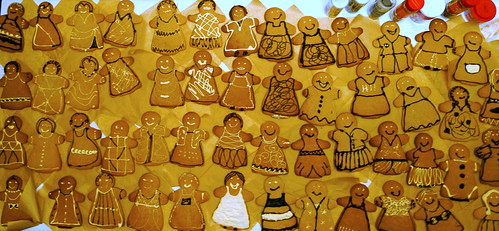
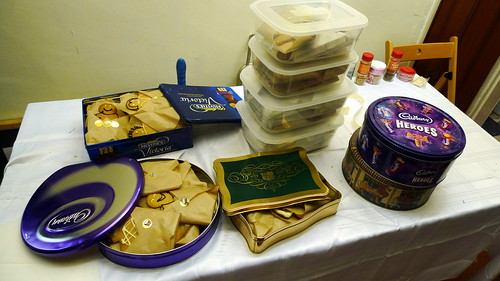
Richard was a star and ran out for tupperware with mere minutes to go before Sainsbury's closed; when packed up, the 100 gingerbread people looked like this:

What 100 Gingerbread men looks like

Fun!


Makes approx 24 5" men, 50 3"

340 g plain flour
1/2 tsp bicarb
1 heaped tsp ground ginger
1 heaped tsp ground mixed spice
120 g butter
170 g light soft brown sugar
30g golden syrup
40g maple syrup
1 large egg, beaten.
1 heaped tbsp finely processed crystallised ginger

Oven at gas 5/190c

Sift together flour, bicarb, and spices. Rub in the butter, then stir in the sugar and crystallised ginger. Beat the syrup and egg together (if it helps, pop the syrup tin in a bowl of hot water to soften before weighing it out) and stir into the dry ingredients to form a soft dough. Thinly roll out some of the dough onto a floured surface - about the thickness of a £1 coin - and stamp out shapes. Put shapes well spread out onto a sheet of baking parchment and put in the fridge for 15-20 minutes.
Take out of the fridge and put into the oven for 15-20 minutes. While that batch is baking you can gather the offcuts, re-roll and stamp, and put that batch into the fridge to chill. If you use two baking sheets - one for cold, one for hot - and just transfer the baking parchment you can have quite a production line going! Cool on a rack, and when cold pop into airtight boxes, where they should keep crispy for about a week. Don't leave them overnight to cool, though - they'll go soggy.